

Outdoors & Fitness
The Best Bike Bells: 4 Compared (and One to Skip)
The spec that decides a bell is the diameter of your handlebar where it clamps, and it is the spec one of these four does not publish at all.

The short version
The Spurcycle Original is the pick if you own more than one bike, because Spurcycle states a fit range of 22 to 36mm and puts both the small and large bands in the box, so it goes on a drop bar, a flat bar or an oversized clamp area. The Knog Oi Classic is the value choice and the better looking one, sold in two sizes, Small for 22.2mm bars and Large for 23.8 to 31.8mm, with shims and a hex key included. The PDW King of Ding II suits a specific bike: a solid brass bell with a proper alloy band, but the mount is stated for 22.2 to 25.4mm only, so oversized clamp areas are out. Skip the Lezyne Classic Brass Bell unless you can try it first, because it is the only one here that publishes no diameter at all, offering Small and Medium with an O-ring instead of a clamp band. Measure your bar with a caliper before you order anything. Best for: riders who would rather check the number than guess the size.
Our picks at a glance
- Spurcycle Original Bell - Buy. The widest published fit range here, 22 to 36mm with both bands in the box, on a brass dome that is the point of the whole thing.
- Knog Oi Classic Bike Bell - Buy. A bell that wraps around the bar instead of sitting on top of it, sold in two clearly stated size ranges with the shims and the hex key included.
- Portland Design Works King of Ding II - It depends. A solid brass bell on a proper alloy band at the lowest price here, with a fit range that stops at 25.4mm.
- Lezyne Classic Brass Bell - Skip. A handsome brass bell on a machined base, sold in sizes called Small and Medium with no millimetre range published anywhere.
The verdict in 30 seconds
What mattered most
- Published bar fit
- Mounting method
- Stated weight
- Dome or body material
- Tool needed
- What is in the box
A bell is a simple thing sold in an unhelpful way. Handlebars are not one size: the tops of a drop bar are usually 22.2mm or 23.8mm, the clamp area near the stem is often 31.8mm, flat bars are 22.2mm at the grips and wider in the middle. A bell has to close around whichever of those you mount it on. Three of these four publish a millimetre range and one sells sizes called Small and Medium with no numbers attached. None of them publishes a loudness figure, which tells you something about how the category is sold.
The widest published fit range here, 22 to 36mm with both bands in the box, on a brass dome that is the point of the whole thing.
Best for: Riders with more than one bike, or one bike with an unusual bar, who want a bell that will definitely fit.
- Spurcycle states a fit of 22 to 36mm, with a Small Band and a Large Band both included.
- Brass alloy dome and an aluminium hammer, with the dome stated at 30mm across by 20.5mm.
- 45 grams, which is the lightest of the clamp-on bells here.
- Made in the USA, in raw brass or a black DLC finish.
- The range covers a drop bar top, a flat bar and an oversized clamp area, so it moves between bikes.
- A 2.5mm hex tool is required and Spurcycle states it is not included.
- Most expensive bell here by a wide margin.
- No decibel figure published, so the loudness claim rests on description alone.
- The exposed striker collects road grit on a bike left outside.
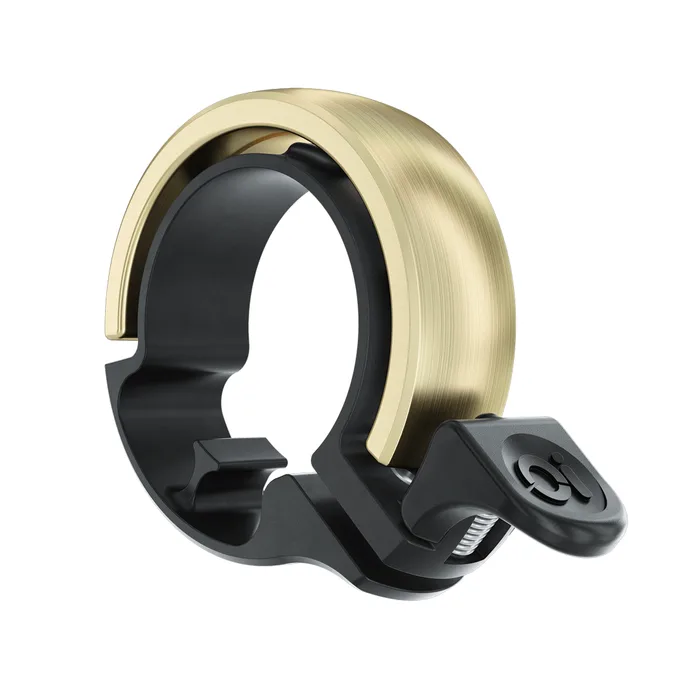
A bell that wraps around the bar instead of sitting on top of it, sold in two clearly stated size ranges with the shims and the hex key included.
Best for: Commuters who want a tidy cockpit and know which of the two size bands their bar falls into.
- Two sizes with numbers attached: Small fits 22.2mm bars, Large fits 23.8 to 31.8mm.
- Shims are supplied with the Large size for an exact fit, and a hex key comes in the box.
- The ring-shaped body wraps the bar rather than standing proud, so it clears levers and bags.
- Knog states a considered cable management system, which matters on a cluttered commuter cockpit.
- Knog describes it as stronger and louder than its predecessor, after a long redesign.
- The two sizes mean you have to know your bar diameter before ordering, with no single bell covering both.
- 60 grams, heavier than the Spurcycle.
- No decibel figure published.
- The low-profile lever is less obvious to find in a hurry than a traditional thumb striker.
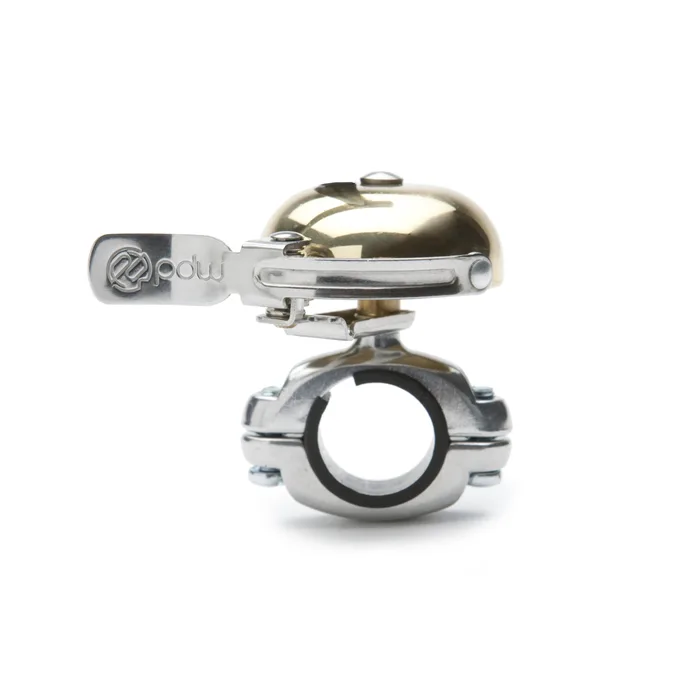
A solid brass bell on a proper alloy band at the lowest price here, with a fit range that stops at 25.4mm.
Best for: A bike with a 22.2 to 25.4mm bar where you want a real brass tone without spending much.
- PDW states the alloy mount fits 22.2 to 25.4mm handlebars, so the number is on the page.
- A solid brass bell rather than a plated one, which is where the tone comes from.
- Offered in raw brass or a black ED coating.
- The least expensive bell in this comparison by some way.
- The stated range stops at 25.4mm, so a 31.8mm clamp area is out without an adapter.
- 86 grams, the heaviest here.
- No decibel figure published.
- A traditional dome sits proud of the bar, so it fouls bar bags and lever hoods more easily than a wrap-around design.
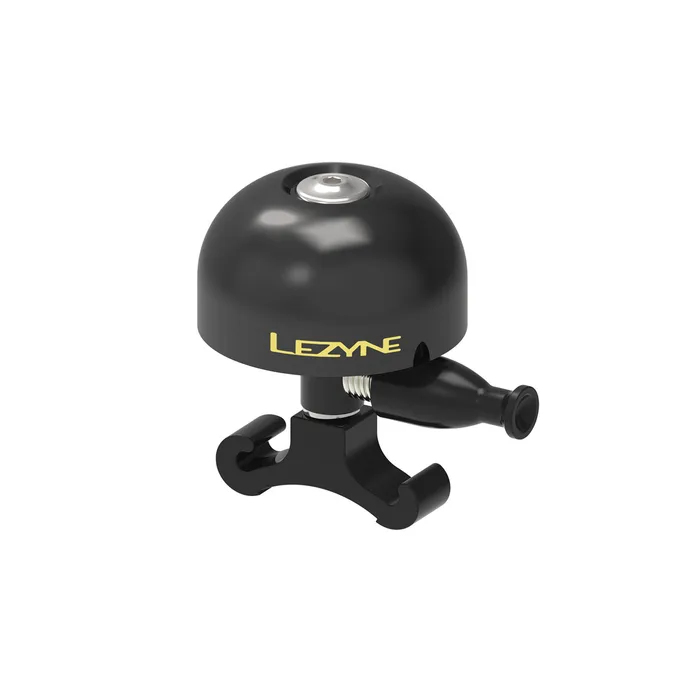
A handsome brass bell on a machined base, sold in sizes called Small and Medium with no millimetre range published anywhere.
Best for: A rider buying in a shop who can hold it against the bar first, or a bike with a tube no rigid band will fit.
- High-polished brass on a machined aluminium base, which is a better standard of construction than the price suggests.
- A low-profile brass striker, and Lezyne describes the ring as crisp.
- The O-ring mount will go onto shapes a rigid band cannot, including non-round tubes.
- A shallower cymbal-style version exists in the same range if you prefer the tone.
- No diameter range published at all, with the sizes given only as Small and Medium.
- An O-ring is an elastic mount, so it is easier to rotate out of position than a clamped band.
- No decibel figure, no published weight on the product page.
- In a category where fit is the deciding spec, being unable to check it before ordering is the main problem.
| Criteria | Original Bell | Oi Classic Bike Bell | King of Ding II | Classic Brass Bell |
|---|---|---|---|---|
| Verdict | Buy it | Buy it | It depends | Skip it |
| Best for | Riders with more than one bike, or one bike with an unusual bar, who want a bell that will definitely fit. | Commuters who want a tidy cockpit and know which of the two size bands their bar falls into. | A bike with a 22.2 to 25.4mm bar where you want a real brass tone without spending much. | A rider buying in a shop who can hold it against the bar first, or a bike with a tube no rigid band will fit. |
| Price tier | $$$ · premium | $$ · mid-range | $ · budget | $$ · mid-range |
| Published bar fit | 22 to 36mm | Small 22.2mm; Large 23.8 to 31.8mm | 22.2 to 25.4mm | Not published; Small and Medium only |
| Mounting method | Clamp band, two sizes supplied | Wrap-around clamp with shims on the Large | Alloy band clamp | O-ring |
| Stated weight | 45g | 60g | 86g | Not published |
| Dome or body material | Brass alloy dome, aluminium hammer | Alloy body, brass finish option | Solid brass on an alloy mount | Polished brass on a machined aluminium base |
| Tool needed | 2.5mm hex, not included | Hex key included | Not stated | Not stated |
| What is in the box | Bell, Small Band, Large Band | Bell, hex key, shims on Large sizes | Bell and mount | Bell and mount |
| Loudness published | No | No | No | No |
| Stated origin | Made in USA | Not published | Not published | Not published |
| Same maker's alternative | 22.2 Compact, flat bars only, 3mm hex required | Oi Luxe and Oi Prima in the same shape | Alexander Graham and Heads Up! Trail Bell | Classic Shallow Brass Bell |
Which one is right for you?
- Riders with more than one bike, or one bike with an unusual bar, who want a bell that will definitely fit. Buy it Spurcycle Original Bell
- Commuters who want a tidy cockpit and know which of the two size bands their bar falls into. Buy it Knog Oi Classic Bike Bell
- A bike with a 22.2 to 25.4mm bar where you want a real brass tone without spending much. It depends Portland Design Works King of Ding II
- A rider buying in a shop who can hold it against the bar first, or a bike with a tube no rigid band will fit. Skip it Lezyne Classic Brass Bell
How we judged the field
Five things decide a bike bell and the first one is not the sound. It is whether the mount closes around your handlebar at the place you want it. Bars vary from 22.2mm on the tops of a drop bar or the grip section of a flat bar, through 23.8mm, up to 31.8mm at the clamp area, and a bell rated for one of those will not go onto another. The second is what the dome is made of and how big it is, because a solid brass dome rings differently from a plated alloy one and a larger dome carries further. The third is the mounting hardware: a rigid band, a wrap-around clamp with shims, or an elastic O-ring, each of which trades adjustability against how firmly the bell stays put. The fourth is what comes in the box, since a bell that needs a hex key you do not own is a trip to the shop. The fifth is where it sits, because a bell your thumb cannot reach does not get rung.
On the first of those the field splits sharply and the split is easy to check, because three of the four print a millimetre range. Spurcycle states 22 to 36mm and supplies two bands. Knog states 22.2mm for the Small and 23.8 to 31.8mm for the Large, and includes shims with the Large. PDW states 22.2 to 25.4mm. Lezyne publishes nothing at all, selling sizes called Small and Medium and mounting with an O-ring. So we took one bell per brand across that spread. The other thing worth saying up front is that none of these four publishes a decibel figure, so loudness cannot be compared numerically and has to be inferred from material and dome size.
Spurcycle Original Bell - buy
The Original is the bell to buy if you are not certain what you are mounting it on. Spurcycle states a fit range of 22 to 36mm and puts both a Small Band and a Large Band in the box, which is the widest published coverage here by a long way and covers a drop bar top, a flat bar grip section and an oversized 31.8mm clamp area with the same product. The bell itself is a brass alloy dome with an aluminium hammer, stated at 30mm across and 20.5mm tall, and the whole thing weighs 45 grams, the lightest of the clamp-on bells in this comparison. It is made in the USA and sold in raw brass or a black DLC finish. The costs are price, which is the highest here, and a detail that catches people out: Spurcycle states that installation needs a 2.5mm hex tool and that the tool is not included. There is also a 22.2 Compact version in the same range, built with 30 percent fewer parts, but that one fits flat bars only.
Knog Oi Classic Bike Bell - buy
The Oi Classic is the one we would buy on price and looks, and Knog has done the useful thing of attaching numbers to both sizes. The Small fits 22.2mm bars and the Large fits 23.8 to 31.8mm, with shims supplied on the Large for an exact fit and a hex key in the box. The design is the interesting part: instead of a dome sitting on top of the bar, the bell is a ring that wraps around it, which keeps the cockpit clear of lever hoods and bar bags and lets Knog build in what it calls a considered cable management system. Knog describes the current version as stronger and louder than its predecessor after a long development. What you give up is the single-product convenience of the Spurcycle, since you have to know your diameter before ordering, and 60 grams against 45. The lever is also subtle, which looks good and is marginally harder to find without looking.
Portland Design Works King of Ding II - it depends
The King of Ding II is the value option and the one with the narrowest fit. PDW states that the alloy mount fits 22.2 to 25.4mm handlebars, which covers drop bar tops and flat bar grip sections but stops well short of a 31.8mm clamp area. Within that range it is a genuinely good bell, because it uses a solid brass dome rather than a brass-finished one, and solid brass is where the tone that people buy bells for actually comes from. It comes in raw brass or a black ED coating, and it is the cheapest thing in this comparison. The trade-offs are size and shape. At 86 grams it is the heaviest bell here, and a traditional dome standing proud of the bar is the design most likely to foul a bar bag, a lever hood or a computer mount. If your bar is in range and your cockpit is uncluttered, it is a lot of bell for the money.
Lezyne Classic Brass Bell - skip
The Classic Brass Bell is the best made thing here that we would still tell most people to pass over, and the reason is a missing number. Lezyne builds it from high-polished brass on a machined aluminium base with a low-profile brass striker, which is a better standard of construction than the price implies. It attaches with a simple O-ring, which Lezyne says suits a variety of handlebar and tube sizes and shapes, and that is true as far as it goes: an elastic mount will go around things a rigid band will not, including non-round tubes. But the sizes are given as Small and Medium with no millimetre range published anywhere on the page, and no weight either. In a category where fit is the whole question, a bell you cannot check against a caliper measurement before ordering is a gamble, and an O-ring is also the easiest mount here to rotate out of position. Buy it in a shop where you can hold it against your bar.
Spurcycle Original Bell vs Knog Oi Classic Bike Bell: which should you buy?
The Original and the Oi Classic are the two to choose between, and the question is whether you know your bar diameter. If you do not, or if you expect to move the bell between bikes, the Spurcycle is the answer: 22 to 36mm covers essentially every bar you are likely to meet, and both bands are in the box, so the decision is made once. It is also the lightest at 45 grams and the only one here with a published dome size, 30mm by 20.5mm, which is the closest thing to a loudness spec anybody offers.
If you do know your diameter, the Oi Classic gives you most of the same certainty for less money and a tidier cockpit. Small for 22.2mm and Large for 23.8 to 31.8mm are clear ranges, the shims on the Large let you fine-tune the fit, and unlike the Spurcycle the hex key is included, so you can fit it the day it arrives. The wrap-around shape is the practical advantage: it does not stand proud, so it is far less likely to argue with a bar bag or a lever hood. Buy the Spurcycle for range and weight. Buy the Knog for cockpit clearance and for getting the tool in the box.
What to look for
- Measure the bar where the bell will actually sit: diameter changes along a handlebar, from 22.2mm at the grips to 31.8mm at the clamp.
- Look for a millimetre range on the page: three of these four publish one, and the one that does not is the one to be careful with.
- Check whether the tool is included: Spurcycle states a 2.5mm hex is required and not supplied, while Knog puts a hex key in the box.
- Prefer solid brass to brass finish if you care about tone: the material of the dome is what rings, and only some makers say which they used.
- Ignore loudness claims without numbers: none of these publishes a decibel figure, so dome size and material are the only comparable evidence.
- Mount for your thumb, not for tidiness: a bell you have to move your hand to reach will not be used when it matters.
Our final take
Bells are bought on looks and returned on fit. Almost every problem in this category comes down to a handlebar being 31.8mm where the buyer assumed 22.2mm, and it is a two-minute measurement that prevents it. Spurcycle’s Original is the one that removes the question entirely, with a stated 22 to 36mm range and both bands supplied, and it is the lightest here into the bargain. Knog’s Oi Classic is the sensible cheaper answer once you know your number, and it comes with the hex key you will otherwise be hunting for. PDW’s brass dome is excellent value inside its narrower 22.2 to 25.4mm range. And a bell sold in sizes called Small and Medium is asking you to guess.
Questions, answered
How do I measure my handlebar for a bell?
Measure the outside diameter at the exact spot you want to mount, because a bar changes diameter along its length. On a drop bar the tops are commonly 22.2mm or 23.8mm while the clamp area next to the stem is often 31.8mm, and on a flat bar the grip area is usually 22.2mm with a wider centre section. Use a caliper if you have one, or wrap a strip of paper round, mark the overlap and divide the length by 3.14. Then compare that number to the range the bell publishes.
Why do bells not publish a loudness figure?
Because nobody makes them and there is no common test. None of these four states a decibel number, and the ones that exist elsewhere in the market are usually attached to electronic horns rather than mechanical bells. What you can compare is construction: a solid brass dome rings differently from a plated or alloy one, and a bigger dome generally carries further. Spurcycle publishes a dome size of 30mm by 20.5mm, which is more useful than a marketing adjective, and PDW states solid brass rather than brass-finished.
Does a bell actually help, or should I just shout?
They do different jobs. A bell reads as polite and impersonal, which is why it works better on shared paths where a shout startles people, and its tone carries through headphones better than a voice at conversational volume. A shout is better when you need to convey direction or urgency. Most experienced commuters use both, ringing early at distance and speaking when close. The practical requirement for the bell is that your thumb can reach it without moving your hand off the bar.
What if my bar is carbon?
Check the clamping force before you fit anything, because a band clamp tightened hard onto a carbon bar can crush it. Many bells are light enough that finger tight plus a fraction is sufficient, and shims spread the load, which is part of why Knog supplies them with the Large size. If the bell has no torque guidance, mount it on an alloy section such as the stem clamp area of a flat bar, or use a rubber shim of your own. An O-ring mount, as on the Lezyne, applies very little point load but is correspondingly easier to twist out of place.
Where should the bell go on the bar?
Wherever your thumb reaches from the position you ride in most. On a drop bar that usually means the tops, inboard of the brake lever, which is where your hands sit in traffic. On a flat bar it means just inside the grip. The common mistake is mounting it somewhere tidy rather than somewhere reachable, and a bell you have to move your hand for will not get used. Check it clears your lever hoods, any bar bag, and the cables before you tighten.
Deciding between the top two? See our head-to-head: Spurcycle Original Bell vs Knog Oi Classic Bike Bell.
More Outdoors & Fitness reviews
 The Best Bike Chain Lubes: 4 Compared (and One to Skip)
  The Best GPS Bike Computers: 4 Compared (and One to Skip)
  The Best Bike Floor Pumps: 4 Compared (and One to Skip)
  The Best Bike Lights: 4 Compared (and One to Skip)
  The Best Bike Locks: 4 Compared (and One to Skip)
  The Best Bike Multitools: 4 Compared (and One to Skip)