

Outdoors & Fitness
The Best Tent Stakes: 4 Compared (and One to Skip)
Holding power is bought with grams, and one maker's own range prices it exactly: 14g for general soil, 27g for sand and snow, 36g for soft ground.
The short version
The MSR Groundhog is the stake to buy for general use: a Y-beam in 7000-series aluminium at a stated 14 grams and 19cm, sold six to a kit, and MSR states it holds across a wide range of soil conditions. The Sea to Summit Ground Control is the value pick and the cleverest design here, with a three-sided profile in anodised 7075-T6 and multi-height guy points so you can tie off lower when the ground will not take the full length. The Vargo Titanium Ascent suits a specific trip: 10 grams and 158mm of V-shaped titanium that Vargo specifies for sandy soil or snow, which is the wrong shape for hard ground. Skip the NEMO Airpin as your main stake, because at about 5 grams it is a tapered pin with the least holding surface here, even though its three-point cord lock is genuinely smart. For scale, MSR's own sand-and-snow stake weighs 27 grams and its soft-soil stake 36 grams, so grams are what holding power costs. Best for: campers who want to match the stake to the ground instead of to the scale.
Our picks at a glance
- MSR Groundhog Tent Stakes - Buy. The Y-beam that most other stakes are measured against, at a stated 14 grams and 19cm, sold six to a kit.
- Sea to Summit Ground Control Tent Pegs - Buy. A three-sided anodised peg with guy points at several heights, which is the only design here that plans for ground it cannot fully penetrate.
- Vargo Titanium Ascent Tent Stake - It depends. Ten grams of V-shaped titanium that Vargo specifies for sandy soil or snow, which is precise about what it is for and about what it is not.
- NEMO Equipment Airpin Ultralight Stakes - Skip. The smartest head in the category attached to the least holding surface, at roughly five grams a stake.
The verdict in 30 seconds
What mattered most
- Stated weight
- Stated length
- Cross section
- Material
- Ground the maker names
- Guyline attachment
Tent stakes are the cheapest part of a shelter and the part that decides whether it is still standing at 3am. The thing that makes them confusing is that the specification people shop on, weight, runs in the opposite direction to the thing they actually want, which is holding power. MSR is unusually clear about this because its three main models are the same idea at three weights, each labelled with the ground it is for. We used that ladder as the reference and compared four stakes from four brands against it.
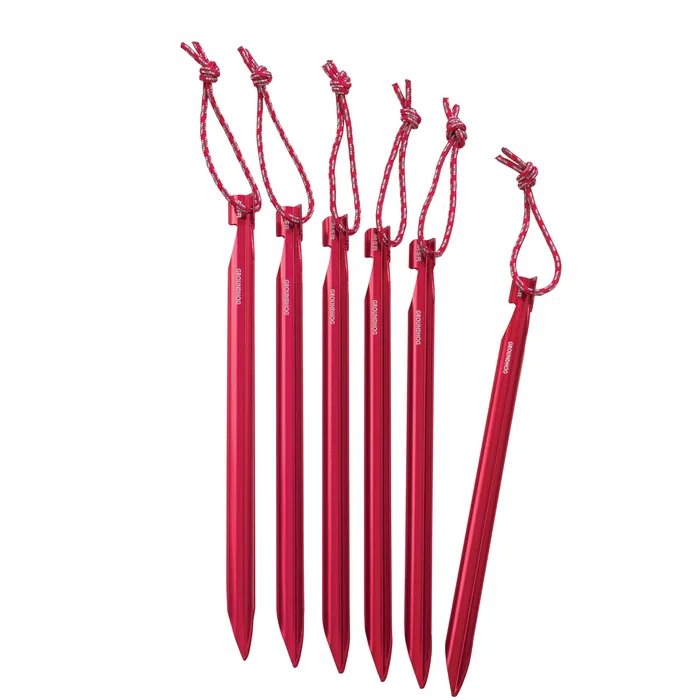
The Y-beam that most other stakes are measured against, at a stated 14 grams and 19cm, sold six to a kit.
Best for: Anyone who owns one set of stakes and pitches on ordinary mixed ground.
- MSR states 0.49 oz or 14 grams per stake and 7.5 in or 19cm of length.
- The three-sided Y-beam resists twisting in the ground, which is what separates it from a round pin.
- MSR states it penetrates and holds across a wide range of soil conditions, so it is the one to own if you pitch in varied places.
- 7000-series aluminium with a reflective pull loop, sold as a kit of six.
- A Mini-Groundhog exists in the same range if you want the same shape lighter.
- At 19cm it is shorter than MSR's own sand and snow models, so very loose ground still defeats it.
- Aluminium bends if you hammer it onto a rock, and a bent Y-beam is hard to straighten.
- The reflective loop is cord, which eventually frays where it passes through the head.
- Sold in a fixed kit of six when many shelters need eight or ten.
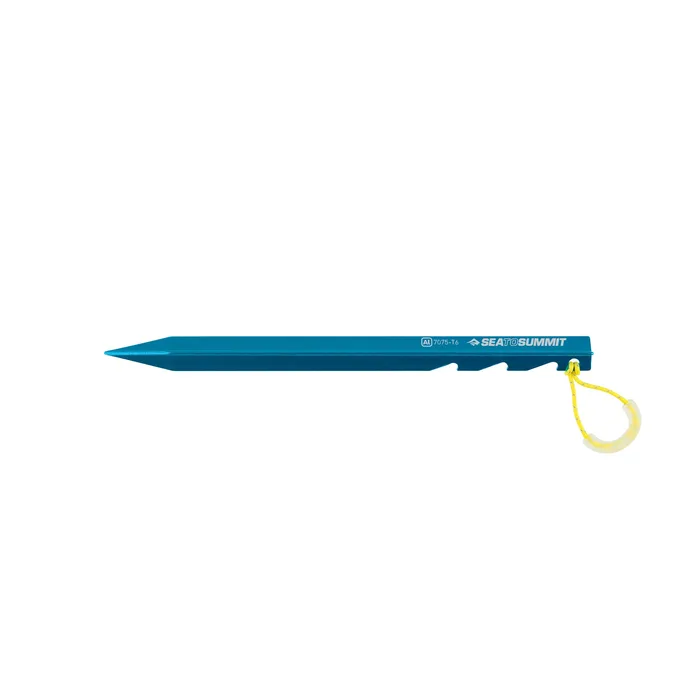
A three-sided anodised peg with guy points at several heights, which is the only design here that plans for ground it cannot fully penetrate.
Best for: Campers who regularly meet rocky or compacted ground where a stake cannot be driven all the way in.
- Anodised 7075-T6 alloy, which is a stronger grade than the general 7000-series description most makers use.
- Multi-height guy points let you attach lower down when the peg will not go in to full depth, which reduces leverage on it.
- Sea to Summit states great holding power in soft or hard ground, so the shape is not specialised to one.
- Reflective cord and a luminescent pull tab, which matters when you are breaking camp before dawn.
- Supplied in a CORDURA Ultra-Sil peg bag, so the set stays together.
- The stated 99 grams is for the Regular set rather than per peg, so per-stake weight takes arithmetic.
- Anodising scratches off the business end within a few pitches.
- A three-sided profile is harder to pull straight out of clay than a round pin.
- Sold as a set in a bag, so replacing one lost peg is awkward.
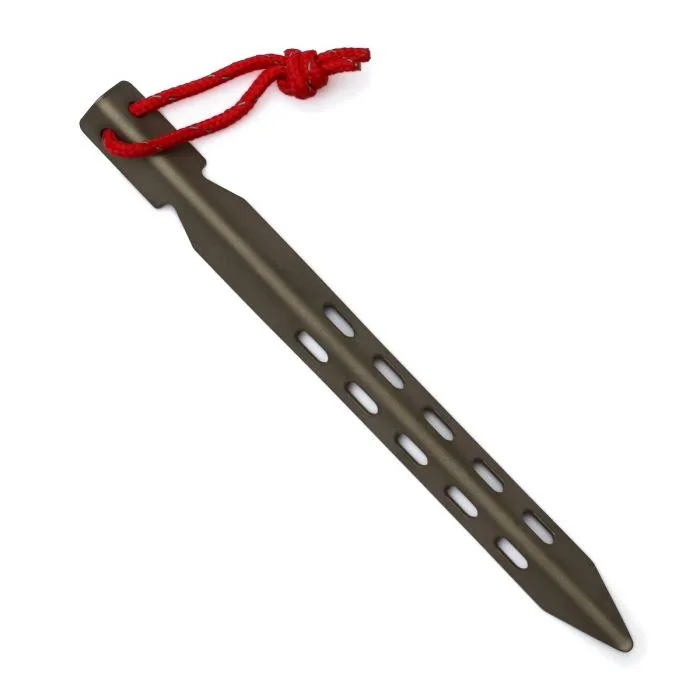
Ten grams of V-shaped titanium that Vargo specifies for sandy soil or snow, which is precise about what it is for and about what it is not.
Best for: Beach, dune and snow camping where surface area matters more than penetration, carried as a specialist set.
- Vargo states 0.35 oz or 10 grams and 6.25 in or 158mm.
- Titanium at this weight resists bending better than aluminium of the same mass.
- The V-shape presents more surface to loose ground than a pin of the same weight would.
- Reflective cord attached, which Vargo says aids visibility and removal.
- Vargo names the ground it is for, sandy soil or snow, instead of claiming it does everything.
- A V-section is awkward to drive into hard or stony ground and will deform at the head if you force it.
- At 158mm it is shorter than the dedicated sand and snow stakes other makers sell.
- Titanium costs considerably more per stake than aluminium.
- Sold singly, so a full set is an expensive order.
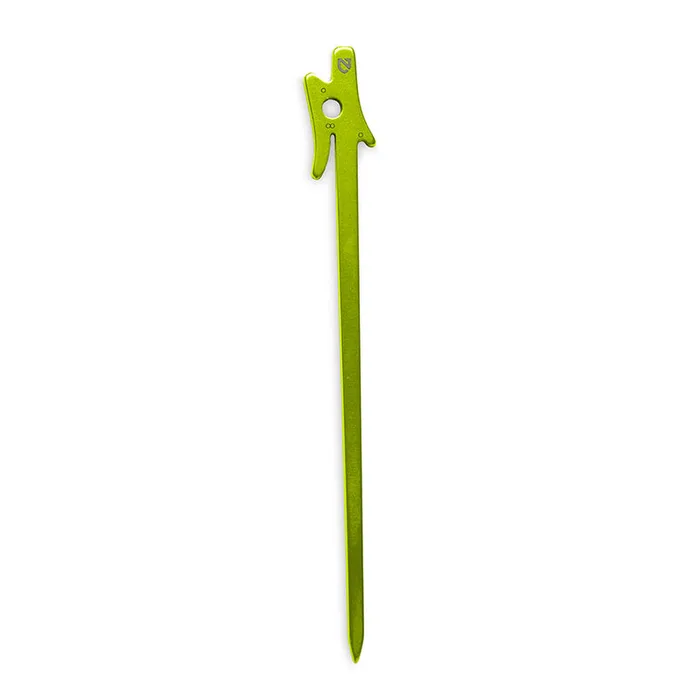
The smartest head in the category attached to the least holding surface, at roughly five grams a stake.
Best for: Gram-counting thru-hikers pitching on firm ground who want the guyline tensioner built into the stake.
- NEMO states a minimum weight of 0.4 oz or 10 grams for the set of two and 0.7 oz or 20 grams for the set of four.
- The three-point locking system holds guyline directly, so knots, cord locks and separate line tensioners become unnecessary.
- 7075 aluminium, which is the stronger grade, and a tapered geometry that drives easily.
- At 1 by 6 in, or 2 by 15cm, it is close to full length despite the weight.
- A tapered pin presents the least surface to the ground of any shape here, which is where holding power comes from.
- NEMO lists the best use as ultralight backpacking and thru-hiking, which is a narrower brief than a general stake.
- Sold in sets of two and four, so staking a shelter properly means several packs.
- The cleverness is in the head, and the head is no help once the shaft pulls out of soft ground.
| Criteria | Groundhog Tent Stakes | Ground Control Tent Pegs | Titanium Ascent Tent Stake | Airpin Ultralight Stakes |
|---|---|---|---|---|
| Verdict | Buy it | Buy it | It depends | Skip it |
| Best for | Anyone who owns one set of stakes and pitches on ordinary mixed ground. | Campers who regularly meet rocky or compacted ground where a stake cannot be driven all the way in. | Beach, dune and snow camping where surface area matters more than penetration, carried as a specialist set. | Gram-counting thru-hikers pitching on firm ground who want the guyline tensioner built into the stake. |
| Price tier | $$ · mid-range | $$ · mid-range | $$$ · premium | $$$ · premium |
| Stated weight | 14g (0.49 oz) per stake | 99g for the Regular set | 10g (0.35 oz) per stake | About 5g per stake, from 10g per set of two |
| Stated length | 19cm (7.5 in) | Not published per peg | 158mm (6.25 in) | 15cm (6 in) |
| Cross section | Y-beam, three sided | Three sided | V-shaped | Tapered pin |
| Material | 7000-series aluminium | Anodised 7075-T6 alloy | Titanium | 7075 aluminium |
| Ground the maker names | A wide range of soil conditions | Soft or hard ground | Sandy soil or snow | Not named; best use given as ultralight backpacking |
| Guyline attachment | Reflective pull loop | Multi-height guy points, reflective cord, luminescent tab | Reflective cord attached | Three-point locking system, no tensioner needed |
| Sold in packs of | 6 | A set with a peg bag | 1 | 2 or 4 |
| Same maker's heavier option | Blizzard 27g for sand and snow; Cyclone 36g for soft soil | Ground Control in more than one length | Crevice Stake, 10g, for soft ground | None heavier in the Airpin line |
Which one is right for you?
- Anyone who owns one set of stakes and pitches on ordinary mixed ground. Buy it MSR Groundhog Tent Stakes
- Campers who regularly meet rocky or compacted ground where a stake cannot be driven all the way in. Buy it Sea to Summit Ground Control Tent Pegs
- Beach, dune and snow camping where surface area matters more than penetration, carried as a specialist set. It depends Vargo Titanium Ascent Tent Stake
- Gram-counting thru-hikers pitching on firm ground who want the guyline tensioner built into the stake. Skip it NEMO Equipment Airpin Ultralight Stakes
How we judged the field
Five things decide a tent stake and only two of them appear in most product titles. The first is cross section, because a Y-beam, a three-sided profile, a V and a round pin present very different amounts of surface to the ground and surface is where holding power comes from. The second is length, which decides how much of that surface is actually buried. The third is the ground the stake was designed for, and the makers who name it are doing you a favour. The fourth is weight, which is the price you pay for the first three. The fifth is the head: how the guy line attaches, whether you can tie off at more than one height, and whether you will find the stake again in the dark.
The useful thing about this category is that one maker has already done the comparison for you inside its own range. MSR sells the Groundhog at a stated 14 grams for a wide range of soil, the Blizzard at 27 grams for sand and snow, and the Cyclone at 36 grams for soft soil. Same company, same problem, three weights, each with the ground written on the label. That ladder is the reference point for everything else here, so we took the Groundhog as the general-purpose benchmark and set three other brands against it: a three-sided anodised peg that solves the half-driven problem, a titanium V specified for sand and snow, and a five gram pin with a tensioner built into the head.
MSR Groundhog Tent Stakes - buy
The Groundhog is the stake other stakes get compared to, and it earns that by being unremarkable in the right way. MSR states 0.49 oz or 14 grams and 7.5 in or 19cm, in 7000-series aluminium, with a Y-beam cross section that resists twisting in the ground in a way a round pin cannot. The claim on the page is the important part: it penetrates and holds in a wide range of soil conditions. That is a narrower claim than it sounds, because most of this category is specialised, and a stake that is merely good everywhere is the right thing to own if you pitch in different places. It comes six to a kit with a reflective pull loop, and there is a Mini-Groundhog in the same range if you want the shape lighter. The limits are real: at 19cm it is shorter than MSR’s own sand and snow models, aluminium bends when it meets a rock, and six is fewer than many shelters need.
Sea to Summit Ground Control Tent Pegs - buy
The Ground Control is the most thoughtfully designed stake here and the one we would buy if our usual pitches were stony. Sea to Summit specifies anodised 7075-T6, which is a stronger and more specific grade than the general 7000-series most makers quote, in a three-sided profile that the company says holds well in soft or hard ground. The feature that sets it apart is the multi-height guy points. When the ground will not take a stake to full depth, the usual outcome is a stake standing proud with the line at the top, which turns the whole thing into a lever that pivots straight out. Being able to attach the line lower down removes most of that leverage, and it is the only design here that plans for the situation. The head also carries a reflective cord and a luminescent pull tab, and the set ships in a CORDURA Ultra-Sil bag. The published 99 grams is for the Regular set rather than per peg, which is the one place the page makes you do arithmetic.
Vargo Titanium Ascent Tent Stake - it depends
The Ascent is a specialist and Vargo says so, which is worth more than a broader claim would be. The stated numbers are 0.35 oz or 10 grams and 6.25 in or 158mm, in titanium, in a V-shaped section with a reflective cord attached. The product name on Vargo’s own page reads for sandy soil or snow, and that is the whole proposition: a V presents far more surface to loose material than a pin of the same weight, which is how ten grams of metal holds anything in sand. The corollary is that the same shape is awkward to drive into hard or stony ground and will deform at the head if you insist. Titanium also costs considerably more per stake than aluminium, and Vargo sells these singly, so a full set is a real order. Vargo’s Crevice Stake is the same weight and length in a V aimed at soft ground generally, if your problem is mud rather than dunes.
NEMO Equipment Airpin Ultralight Stakes - skip
The Airpin is the cleverest thing in this comparison and still the one we would not make our main stake. NEMO states a minimum weight of 0.4 oz or 10 grams for the set of two, so about five grams each, at 1 by 6 in or 2 by 15cm in 7075 aluminium. The head is genuinely novel: a three-point locking system grips the guy line directly, which removes the need for knots, cord locks and separate line tensioners, and anyone who has fought a line-lok in the cold will see the appeal. The problem is the other end. A tapered pin presents less surface to the ground than any other shape here, and holding power comes from surface. NEMO lists the best use as ultralight backpacking and thru-hiking, which is an honest signal about the brief. As a supplement, or on firm ground with a shelter that does not load its stakes hard, it makes sense. As the set you own, it asks the ground to cooperate.
MSR Groundhog Tent Stakes vs Sea to Summit Ground Control Tent Pegs: which should you buy?
The Groundhog and the Ground Control are the two to choose between, and the question is what your ground is usually like. If you pitch on ordinary mixed soil and want one set that works, the Groundhog is the straightforward answer: a Y-beam at 14 grams and 19cm, in a kit of six, with MSR stating a wide range of soil conditions rather than a specialism. Nothing here is easier to recommend to somebody who has not thought about stakes before.
If your pitches are stony, compacted or root-filled, the Ground Control is the better tool, and the reason is the head rather than the shaft. A stake you can only drive halfway is a lever if the line is at the top, and multi-height guy points let you tie off low and take that leverage away. The 7075-T6 specification is also a step up in stated grade. The trade is that Sea to Summit publishes the weight for the set rather than per peg, and the three-sided profile takes more effort to extract from clay. Buy the MSR as a default. Buy the Sea to Summit if you keep meeting ground that will not take a full-length stake.
What to look for
- Read the shape, not just the weight: a Y-beam, a three-sided profile, a V and a round pin hold very differently at the same mass.
- Look for the ground named on the page: MSR, Vargo and Sea to Summit all name the conditions their stakes suit, and that sentence is worth more than the spec table.
- Use one maker’s range as a price list for holding power: MSR’s own ladder runs 14g for general soil, 27g for sand and snow and 36g for soft soil.
- Check how the guy line attaches: a single loop at the top is a lever when the stake will not go in fully, and multi-height guy points fix that.
- Count the stakes your shelter actually needs: corners, vestibules and guy lines usually add up past the six or eight that come in a pack.
- Buy the shape for your worst pitch, not your average one: the night the stakes matter is the windy one on bad ground.
Our final take
Stakes are bought by weight and judged at 3am, which is why so many people own a set that is lighter than it should be. The honest way to read this category is that grams buy surface and surface buys holding power, and the clearest evidence for that is inside one maker’s own catalogue, where the same company sells 14, 27 and 36 gram stakes with the ground each is for written on the label. The MSR Groundhog is the default because it covers a wide range of soil at a weight nobody has to think about. The Sea to Summit Ground Control is the one to own if your ground fights back, because it is the only design here that plans for a stake it cannot fully bury. And a five gram pin is a supplement.
Questions, answered
Why do heavier stakes hold better?
Because holding power comes from the surface the stake presses against, and more surface generally means more metal. MSR's own range shows the trade with unusual clarity: the Groundhog is 14 grams for a wide range of soil, the Blizzard is 27 grams for sand and snow, and the Cyclone is 36 grams for soft soil. Those are the same company solving the same problem at three weights. If you are choosing between a 5 gram stake and a 27 gram one, you are not choosing between two versions of the same thing.
How many stakes do I actually need?
More than come with most shelters, and more than the packs are sized for. A simple two-person tent needs four corners plus two vestibule points, and any shelter you expect to hold in wind needs its guy lines staked too, which is another four to six. MSR sells the Groundhog six to a kit and NEMO sells the Airpin in twos and fours, so plan on buying two packs. Carrying two or three spares costs very little and covers the one you bend and the one you leave in the ground.
What do I use in sand or snow?
A different shape, not a longer version of the same one. Sand and snow hold a stake by friction against a large surface, which is why the stakes made for them are wide, flat or V-shaped and why they weigh two to three times what a general stake does. Vargo specifies its V-shaped Ascent for sandy soil or snow and MSR's Blizzard, at 27 grams, is named for exactly those conditions and can also be buried sideways as a deadman anchor. In deep snow the deadman method, burying any stake or a stuff sack horizontally, holds better than anything driven vertically.
What if the ground is too hard to drive a stake fully in?
Tie off lower on the stake rather than leaving it standing proud with the guy line at the top. A stake half driven and loaded at the head is a lever, and it will pivot out. Sea to Summit designs the Ground Control around this with guy points at several heights so you can attach nearer the ground and cut the leverage. With stakes that have only one attachment point, the improvised version is to loop the line low on the shaft and pile a rock on it.
Are titanium stakes worth the money?
They are worth it for weight and for resistance to bending at a given mass, which is why they dominate the ultralight end. They are not magic: a thin titanium stake still pulls out of soft ground because the failure there is the ground giving way rather than the metal. Buy titanium if you are counting grams and pitching on ground that holds. Buy aluminium in a better shape if you want holding power, since shape buys more of it per gram than the metal does.
Deciding between the top two? See our head-to-head: MSR Groundhog Tent Stakes vs Sea to Summit Ground Control Tent Pegs.
More Outdoors & Fitness reviews
 The Best Trail Running Shoes: 4 Compared (and One to Skip)
  The Best Treadmills: 4 Compared (and One to Skip)
  The Best Trekking Poles: 4 Compared (and One to Skip)
  The Best Via Ferrata Sets: 4 Compared (and One to Skip)
  The Best Adjustable Weight Benches: 4 Compared (and One to Skip)
  The Best Weighted Vests: 4 Compared (and One to Skip)